Performance Analysis (PTS)
Week One: Passing
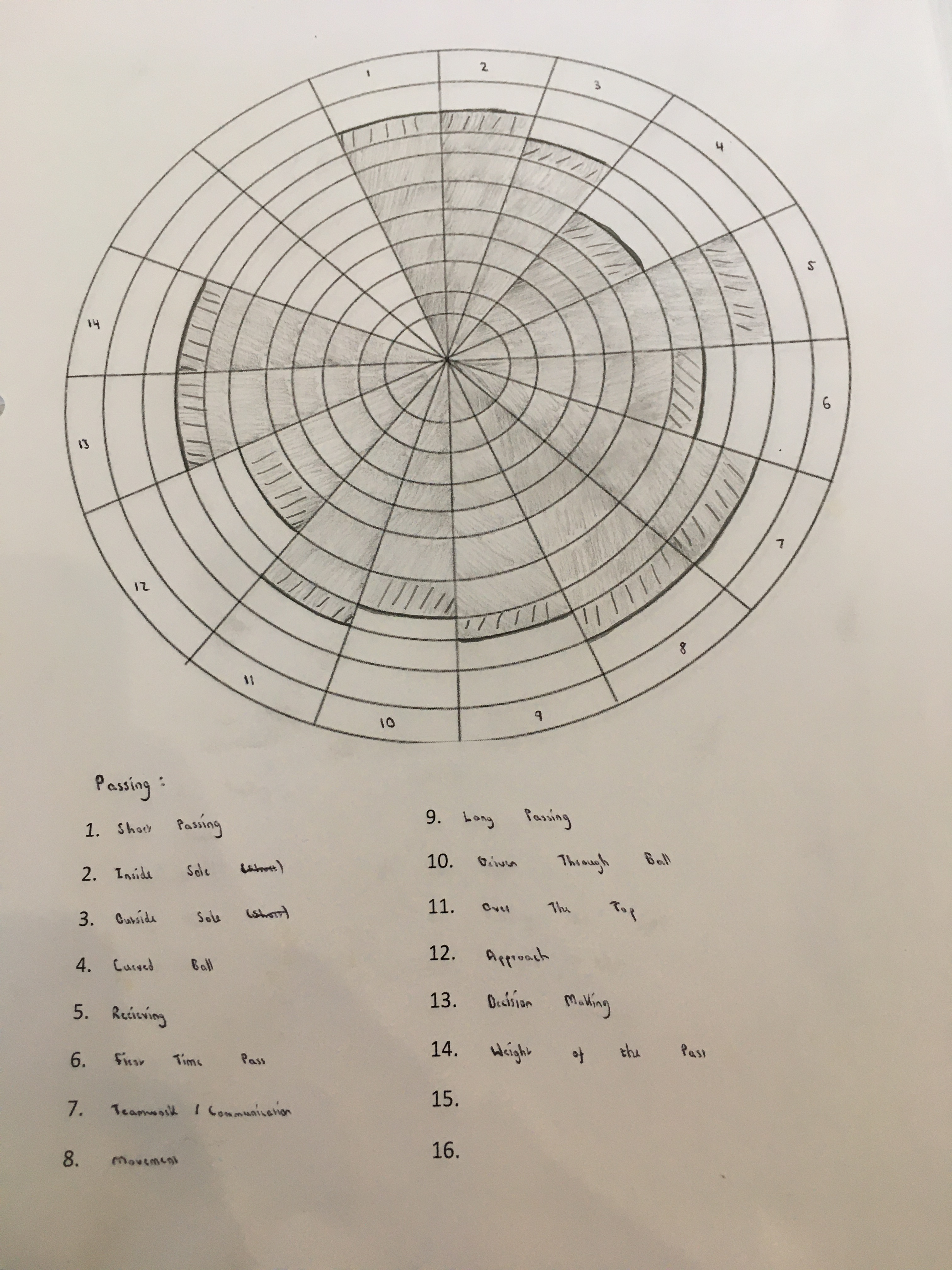
Short passing is utilised in order to retain possession in a safe manner by covering small distances, or in order to build up attacks slowly/quickly with teammates.
To start, the player should take a run-up and approach the ball, planting their non-striking foot 2-3 yards in line with the ball, allowing room for the body to rotate from the hips down to the legs, giving power to the pass.
To achieve accuracy on the pass, the non-striking foot should also be pointed towards the direction of where the pass intends to go. In the first video, the foot is pointed towards the camera, in which the ball heads to in the second video, despite my body not facing there.
The striking foot should be swung with control by locking the ankle, making contact with the ball on the inside of the boot, giving a controlled pass. This is shown in the second video.
My overall strength of the passing week was the accuracy as I’ve applied the placement of the non-striking foot in the direction of where I want to pass, making my leg rotate into the lane.
My weakness at times was applying enough power as my leg didn’t swing from the hip at times, reducing the overall pace in the striking leg. (9/10)
Long Passing:
Long passing is more risky than short passing, with the intending idea to switch play onto another flank, or play a ball behind the defence to a surging run.
To approach, place the non-striking foot 2-3 yards in line with the ball, again facing the direction where you want to play the pass. This time, open up your body (chest open) in order to give additional height, if not, the ball will most likely be played across the ground.
This time the striking foot should also be connecting with the laces, so the toes should essentially be facing outwards. By connecting with the laces, backspin is applied which keeps the pass straight, so the flight of the ball doesn’t veer off from the designated player’s position. The foot itself should be placed to be underneath the ball, lifting the ball from there to complete the pass.
My strengths for this skill was that I achieved distance with the pass due to giving pace as of opening up my body – providing a greater swinging motion for pace.
The second video shows that my pass could have been higher with applied back-spin, but my contact with the ball was met fairly high up – the foot wasn’t placed underneath as much as it could have been. (7/10)
Week Two: Receiving And Turning

When faced with a defender close up against the body, taking a quick touch allows more space to open up. If there’s not a defender, then there’s space to drive into quickly, or take their time to take the ball under control.
To ensure the right touch is taken, a slight check over the shoulder allows the player to analyse their environment around them, whether their first touch can be controlled, or whether a defender is closing the space near. Doing this constantly allows for quicker thinking to the situation.
My strength for this week was that I constantly checked my shoulder and this allowed me to drive into space with the appropriate touch.
My weakness for this week was that the ball would at times get stuck underneath my foot. My body position at times my body would also be over the top of the ball, making me lose my balance or giving little room to change direction quickly.
Hook:
In the video below, the player checks his shoulder as the ball is played into him, and at this point the perception is that there is a defender closing in.
Next the player bends his leg and hip, of which he’ll take the touch with, and make contact with the outside of the foot, making the ball spin around the player. As the ball spins around the player, the oncoming defender that has pressed is turned quickly.
An issue of my hook during training was that at times I used to make the hook too obvious, making it easier for the defender to close me down, or pressure me. To improve, the hook should be disguised as a pass, or the body should fake by shifting its weight to the opposite side of the turn. (6/10)
Cruyff:
To perform the Cruyff, the player should begin by planting the opposing foot, which won’t be making contact, slightly behind the ball (toes in line with the back of the ball).
The other leg should be disguised as a swinging motion, making the scenario seem like a cross is about to happen. This motion allows there to be space opened up as the defender comes across to block the supposed “cross”.
As the swinging motion is in play, the leg is then bent back into the body, and the toes should make contact at the end of the ball – dragging the ball backwards with control. If contact isn’t made with the toes, then the cut-back is harder to control, as the ball is now further away.
My area of weakness for the Cryuff was that the foot would make contact often at the inner sole, not the toes. By doing this, the turn would be taken too far away from the body, leading to someone getting tackled, so I should attempt to make contact at the end of the foot. Otherwise, the turn is performed at high speed and was overall disguised as a cross. (7/10)
Stop:
When dribbling with the ball, plant the sole of the foot, preferably the one that’s dribbling, on top of the ball and turn the body to dribble the other way.
To open up more space, the player can disguise the stop by feinting the body to go over the ball, seemingly still running straight.
When stopping with the ball, an error I’d constantly do is that the stop would make the ball roll forwards and collide into my heel – the ball continues to roll away. This happened due to my weight shifting over the ball, rather than just applying a simple touch with my body being balanced. (4/10)
Drag:
As the defender is dribbling with some pace, the drag aims to cut the ball back and cut back inside. When dribbling, the foot, which is dragging the ball back initially, faces straight, and rolls the ball from around the front area of the sole.
From there, the foot that’s rolled it back should quickly be placed behind the roll, and make contact with the ball on the inside part of the foot, moving the ball behind the other foot.
Overall, I performed this with effect in my performance; ability to turn and take the ball past opponents with pace and trickery as the weight of my body feints to cover the turn. (9/10)
Step-Over:
As the player is dribbling, the body’s position should go slightly to the side of the ball, opposing the way of the step-over. Then, the leg should be bended and go around the front of the ball, with the weight of the body going over to the side of the step-over, providing a body-feint.
Once back around, the player can either do another step-over or, using the feint given by the weight of the body going in another direction, can go and run onwards into the space as the defender has fallen for the fake.
Despite performing the step-overs effectively, my body’s position wasn’t over the ball, but rather leaning to the side, making me lose balance to also lose control. (8/10)
Week Three: Control
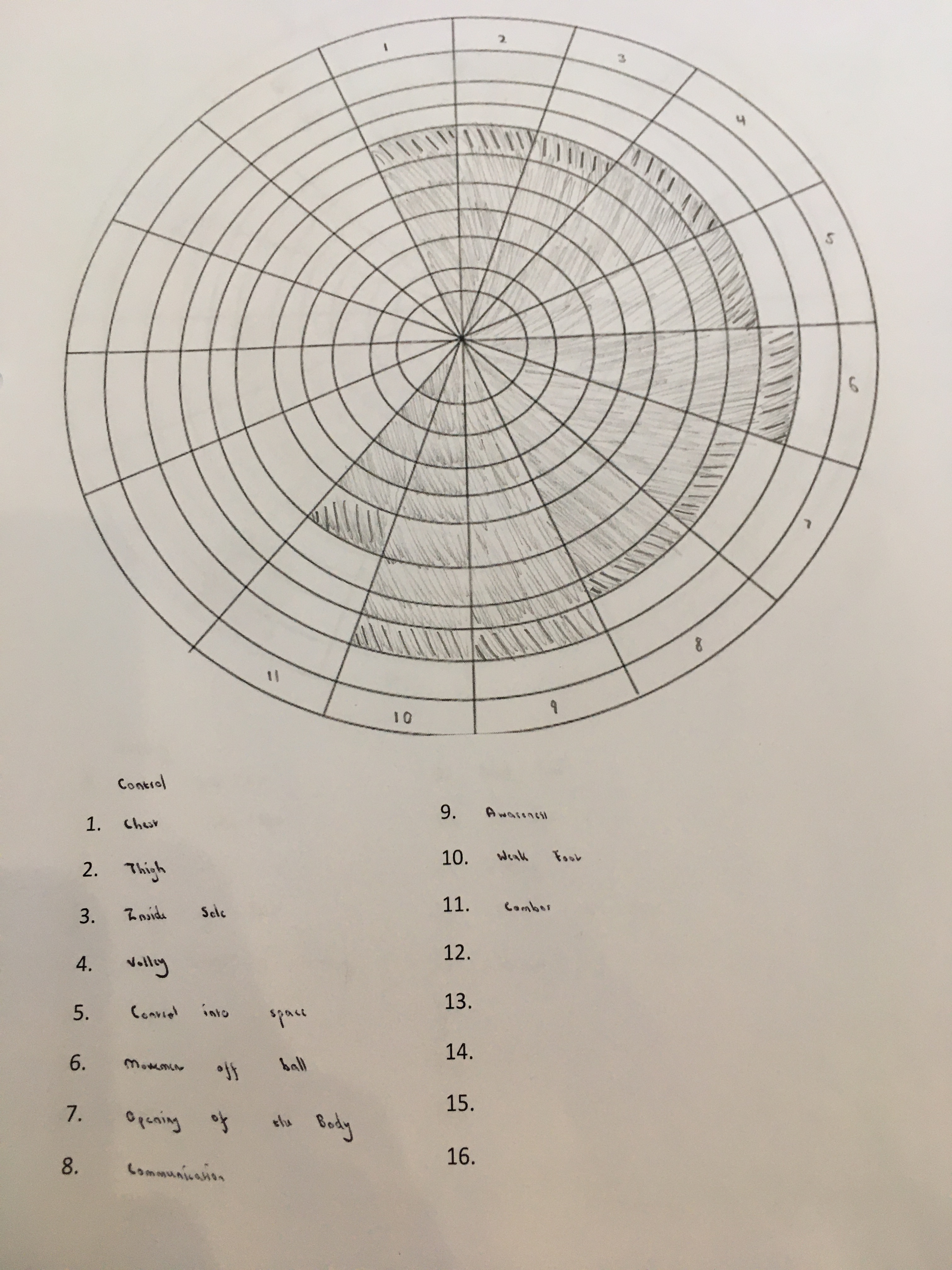
Controlling the ball is the ability to take either an aerial ball or a ball passed along the floor, with some pace or a lot, down with the ball under control at the foot. Controlling can be achieved with any limb of the body – leg/thigh, chest or the foot.
For an easier time, the player should keep their eyes on the ball the entire time, which helps identify which side of the body should be utilised to control the ball – if the ball is on the left side of the body, the ball should be controlled with any part of the body that’s on the left.
To ensure that their body isn’t over the top of the ball, the player should give a distance in their run-up, so the ball can arrive at the appropriate height – the chest control should be timed to arrive at head height, so the distance should be greater than that of the laces control, which should arrive at leg height.
This week my strengths were that I was able to control the ball with all my limbs, whilst returning the ball with pace as of the use of my body – constantly opening up my chest, also rotating my hips when required for power, and keeping my leg sturdy.
However, my negative was that at times the ball was inaccurate with the return. This was due to the ball not contacting at the exact location on the foot – the ball sometimes hit my toes instead of my inside sole/my ankle as opposed to my laces. To adjust this, I should have more space to run into, allowing more time to take the touch under, ensuring that the ball wasn’t on top of me; for the inside sole, the ball would often come to my hips instead of my lower thigh area.
The videos below show the drills that players can do to improve their control:
Chest:
To take the ball down with the chest, the player should approach with a certain distance from the ball. This way the ball can’t arrive below he chest area – the flight of the ball actually has to be slightly above the chest, and the body from there should be opened up (chest forward with arms back). The opened up body allows the body to absorb the impact of the pass, taking all the pace off the ball, controlling it downwards to kick back with either the inside-sole or laces.
The control is performed at a high level, however an often mistake is that the chest could launch the ball upwards slightly to provide more time for an appropriate second touch, allowing an option for a volley or inside controlled pass. Despite taking most balls down, I would kill the pace of the ball too much, not allowing me to react as the ball drops straight down. (7/10)
Inside Sole:
Keeping the eye on the ball again, the player has analysed that the ball is arriving at the lower leg area. To help decide which side takes it down prior to the throw, the player can point towards which side the ball should be thrown, whilst the player also approaches from an angle. The angle given allows more space for the body to move into, providing the ability to rotate the body’s hips to give power to the back-pass.
When making contact with the ball, the hips should be rotated as mentioned for power on the return. The leg which touches the ball is bent upwards and kept sturdy, with the ankle locked; sturdiness allows for a greater support when moving forwards, so the ball goes straight with the return. The foot itself is pointing outwards at a forty-five degree angle allowing contact to be made at the inner sole.
The inside sole makes contact well with the ball is the centre whilst pointing downwards at a forty-five degree angle, whilst also being sturdy, but can at times lack direction. My weakness of directing the ball can be fixed by pointing my hips in the direction of the intended destination, and also keeping my back straight, as leaning back makes me lose balance and can cause the ball to go too high. (9/10)
Thigh:
When the pass is coming to a height around the hips/thigh area, this control is the most useful.
To perform the control, the entire body should be relaxed – leg, which is controlling the ball, has it’s patella facing downwards, otherwise the ball would just hit the leg straight on and be out of control.
Right before the ball hits, the leg should be raised slightly as the body hops towards the ball. The raised leg cushions the ball, like the chest, taking all the pace off the ball, making it drop to effectively be returned with the inner sole or laces. The inner sole touch is provided by which side of the ball is on the return from the thigh.
The control is taken well, but can at times go away from the body at a large distance – the thigh is not relaxed and is swung towards the ball too fast, as opposed to being slower to cushion the ball better. (7/10)
Volley:
When the ball is at the level of the patella (kneecap), pull your chest out with the arms, opening up the body. With the body opened up, it keeps the volley under control/doesn’t raise the volley too much.
With the contact, the leg undergoing the volley will be stretched out straight and the ankle is locked, making the foot face forty-five degrees downwards. This should allow the ball to hit the upper-laces (around the ankle) to raise the ball.
The height of the ball should also be helped by the momentum taken from the opening of the body.
Sometimes the ball would make contact to the side of the centre, resulting in the ball being shot off at an angle, rather than being straight. The ball should be connecting at the centre, so I could improve by watching the ball with more concentration. (7/10)
Week Four: Dribbling
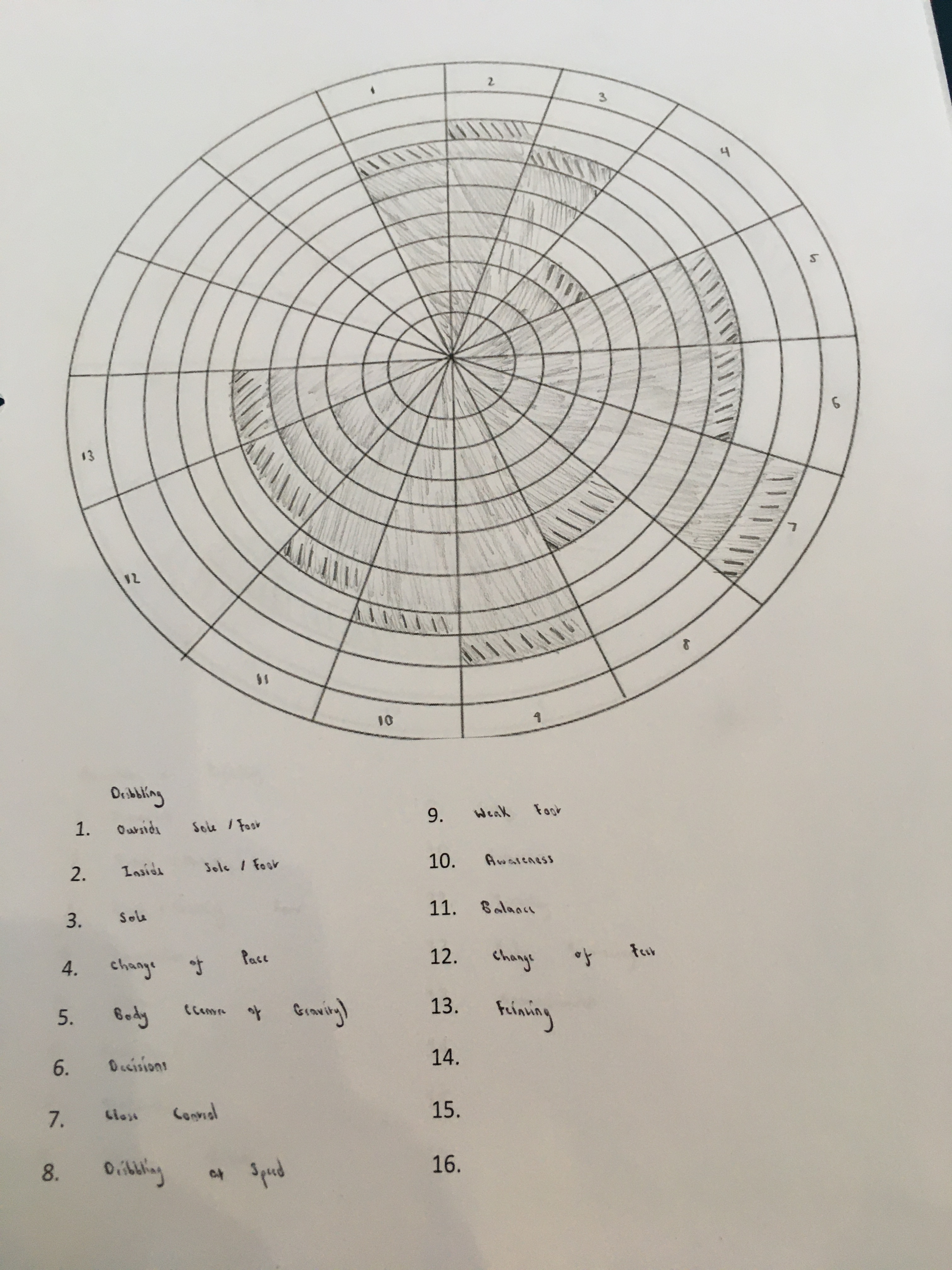
Dribbling is most effective to get out of tight spaces, so using all the area of the foot is more efficient, allowing for quicker turns and better control. All the touches required is the inside and outside of the foot, with the sole as well. If trained effectively, all can be used in combination to evade even quicker.
In the lesson I utilised all areas of my foot well, keeping the ball under control by positioning my body over the ball, so that all the areas of the foot can take quick turns away from the cone/defender.
However, when it came to dribbling into more space/an open lane, my touches would be too small, making me not drive into the space quickly enough, giving time for defenders to get back. To avoid this, I should try to have my foot pointing downwards at a forty-five degree angle to cushion a heavy touch more, whilst keeping my centre of gravity low by positioning my body lower to turn quicker.
Outside Foot:
When running with the ball, the outside foot is the most common when it’s faced with turning.
To turn with pace, the body position of the dribbler will have to be slightly to the side and lowered for a reduced centre of gravity – a lower centre of gravity enables quicker turns as of less air resistance. The dribbling leg should be bent downwards for this as well.
The laces of the boot should be facing the ball, so the foot is pointing forty-five degrees away, and makes contact around the side of the laces.
To utilise the other foot, the body position would have to change to the other side, and repeat the process. The more trained the individual is, the greater the speed in which the feet are rotated.
The skill is performed pretty well, with the ability to take touches forward either with explosive movement, or to control to turn. However, the skill could utilise the addition of my arms, allowing for even greater agile movements, whilst maintains balance, which often doesn’t happen. (7/10)
Inside Foot:
The inside Foot is more common when shifting the ball across to the other foot’s outside touch, or using body weight to move the ball quickly across a body.
Again, the centre of gravity should be lowered to enable the outside touch to be taken quickly, but training the inside touch individually can be done regardless.
The ball should make contact with the foot at the centre. Depending where the ball is intended to head, the foot should be pointing forty-five degrees away if it’s being used to position the outside touch, or can be applied for the body to jump across to the other inner sole, in which the foot is facing directly forwards.
The skill again is performed with pace and control, but can do with angling the foot outwards more, leading to the ball being launched forward into more space. The space gained can be used to drive or even use the other foot/outside of the same foot. (8/10)
Sole:
The sole overall can change your direction completely, be either rolling the ball backwards, stopping the ball to feint/turn in another direction, or rolling the ball to the side.
To roll the ball, place your sole on the ball, bending the same leg and shift your weight to the other side of the body. At that point, the ball rolls over to your side to get away with either the inside/outside touch from before.
The body at times isn’t kept behind the ball and this results in the roll going into the side of the leg; the roll is still performed with pace and is taken around the cones, though. (7/10)
Week Five: Defending and Attacking Principles
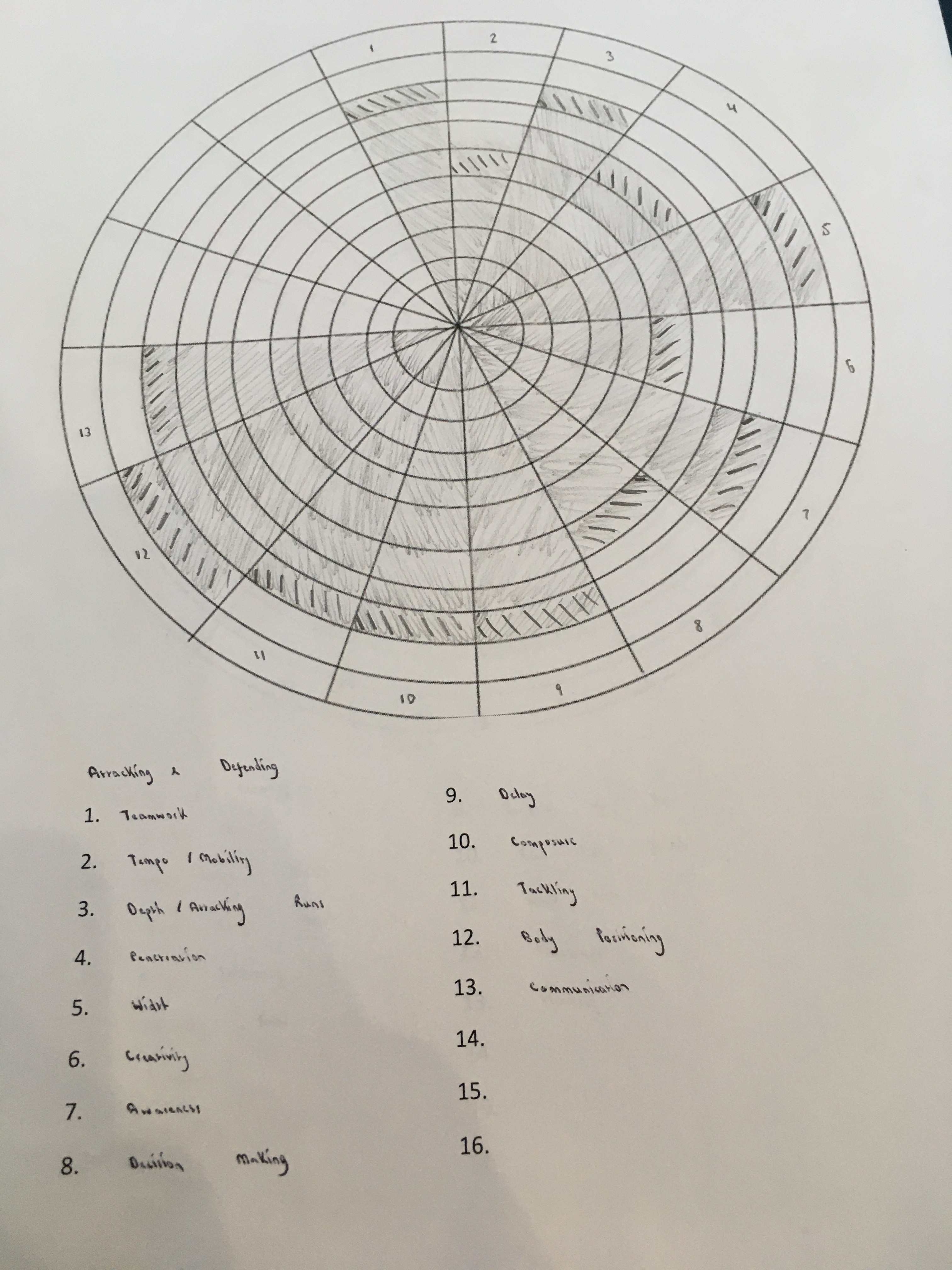
Defending Principles:
When defending, it’s usually in a situation of where the defender is under pressure from an attack with speed/counter-attack, or in a one-one situation.
Delay:
One principle of defending is to delay the attacker. By limiting the options the attacker has, by either showing them on their weak foot or on the outside, the player takes their time, allowing other defenders time to get back and cover you.
In the clip below, the defender keeps the momentum of the attack at a standstill due to showing the attacker on the outside, causing no chance of getting down the middle. From there, once out wide, the defender is still showing the attacker down the line, preventing any chance of a pull-back, which has delayed the opportunity and other defenders have come back.
Depth:
Depth is also an important part to consider when defending, usually how high you press the attacker, or how deep you sit. Sitting high can force the opposition backwards and reduce space once other midfielders come into play, which upon winning, starts a quick counter. Sitting deep can the protect the space in-behind the defence, picking up long/through-balls, also removing options for the attacker, slowing down an attack to force an error, or the attacker down one area. However, unlike the high-press, it doesn’t restrict space as closely and can let an attack build in the meanwhile; doesn’t often start a splitting counter once won. That being said, the high-press is easier to break through due to there at times being multiple gaps via players leaving their positions.
An individual’s depth can influence an attack as well in a one-on-one situation. If a defender stands too far off an attacker, then the attacker can easily pick a pass, use the defender’s momentum against them, or simply run into more space. However, a defender, if standing 3-4 yards away from the attacker, can restrict the movement of the attacker, severely limiting options for the attack.
In the video below, the defender is around 3-4 yards away. As shown, the attacker is limited to little space as the defender is on top of them – can’t turn away easily. If the defender was an extra 2 yards away, the attacker could simply turn into more space then either pull-back or continue with momentum.
In this second video, the overall depth of the backline has enabled a press on the first attacker, but the second defender is sitting deeper, which has allowed the interception, showing that has different perceptions of depth can influence decisions on attackers, thinking other opportunities on on, even when they’re not.
Balance, Concentration & Composure:
The final three principles go well together: balance, concentration and composure. When faced with an attack, a defender should be sideways-on and low, this way they can maintain their balance whilst dealing with sharp turns from the attacker, or get into a position to quickly accelerate if the ball is knocked past them. The ability to keep this position comes useful with concentration and composure; having concentration and composure to keep watching the ball and not dive in, easily falling for one turn, makes it harder for the attacker to trick the defender. This way the attacker can panic and often cause errors, in which the concentration of the defender notices and tackles, winning back the ball.
In the video, the body of the defender is jockeying the attacker, side-on, applying pressure and not rushing into any tackles, maintaining balance for the defender to turn and claim once got past. The defender, since side-on, can easily catch up due to the body not having to be rotated, which costs a split second which can give all the distance the attacker needs.
The second video shows that the defender isn’t side-one with the attacker and allows too much space for the option to turn. Once turned, the defender has to rotate the body, allowing enough time for the attacker to get away, or potentially is grounded like in the video. The defender also rushes the tackle, which enables the attacker to easily avoid since the defender is again too far away.
Attacking Principles:
An attacker’s main objective is to get the ball from one area to create either a chance by take on defenders or working with teammates.
Penetration:
Penetration is the ability to drive the ball into a given bit of space, or cut through defenders with their dribbling. Have the ability to penetrate allows attacker to enforce tackles from defenders, often winning fouls or opening up space somewhere else by dragging other defenders across, losing their structure.
In the clip below, the attacker notices that there is space behind the defender, takes quick touches to get around and drive into the space, leaving more room to decide the next move, either dragging another defender across to pass or dribble more.
Mobility:
The idea of penetration is also met with the principle of mobility. An attack should contain some form of pace, in order to quickly get into areas of space, quickly passing between players to get around defenders or use pace to turn player quickly. Otherwise, if slow, the attack is contained and defenders can easily get back into the slots and cover.
The clip below shows a good example of an attack with pace, as the transitions of the passes are completed quickly between the team. As one defender goes across, a quick one-two is played, grounding the defender as he’s dragged across from the first pass, allowing space for the another to run into. At that point, the other defenders can’t cover. However, if that second pass was delayed for too long, the pass to the overlapped was off, and the defender could easily get back into position.
Support:
Speaking of teammates, the attacker can’t always take on the defence, as mentioned before the defence can set-up to be deepest or restrict space. The idea to use teammates can allow the attacker to run into a greater space, take a defender out of position by making them follow them, allowing big teammate to run into the space, or lay off quick transitions of the ball to get a new chance. The depth of the attack can also influence; having some players sitting deeper to claim the ball can offer an easier route for the start of another attack, with other players pressing the back line. By having this depth, the attack can cover the entire field, potentially disrupting/overloading the defence’s structure.
As mentioned before with mobility, the clip below shows that the use of teamwork can offer a way past the backline. The backline in this video are set-up across the field and cover any gaps, but the idea of support is that someone has dropped deep to give more space to themselves, with that player dragging out one defender. The player who has pulled the defender out has now played it back into the free overlapping player, as of extra space being upended up, who’s now presented with a chance. If the player didn’t pass it back, the player would be press enter with the same situation as before, no space to run into and inevitably losing the ball.
.
Width:
A principle which goes well with support is the idea of width. Width from an attacker can make defenders doubt and lose their composure/discipline, causing the defence to be stretched across the field, exposing space behind for an under-lap. Attackers can help create chances by dragging the defender across, from a teammate to penetrate the space left in behind. Width can also be utilised to find more space, in which teammates can quickly switch the flank being played on.
From the image below, the defence isn’t covering the other flank, and the attacker has a simple lane to run down into, which has effectively launched an attack.

In the video, the attacking team has utilised the wide areas, and offloaded a quick break by playing a through ball, which was presented by the defence being stretched across the field as of the teams width.
Creativity:
Creativity is another principle. If a attacker is up against an experienced defender, it would be obvious what the attacker intends to do. If that case, the defender can force them into an area with their composure and concentration and force the attacker to do an error. With some form of creativity, other teammates can be played into chances by the attacker tricking the defence, with either skills or intelligence.
In the clip below, the player uses their creativity to get around the player, despite being pressed into little space. As the defender is close, he’s grounded by not being side-on, and the momentum of the skill has taken the player past him.
Week Six: Shooting/Chance Conversion
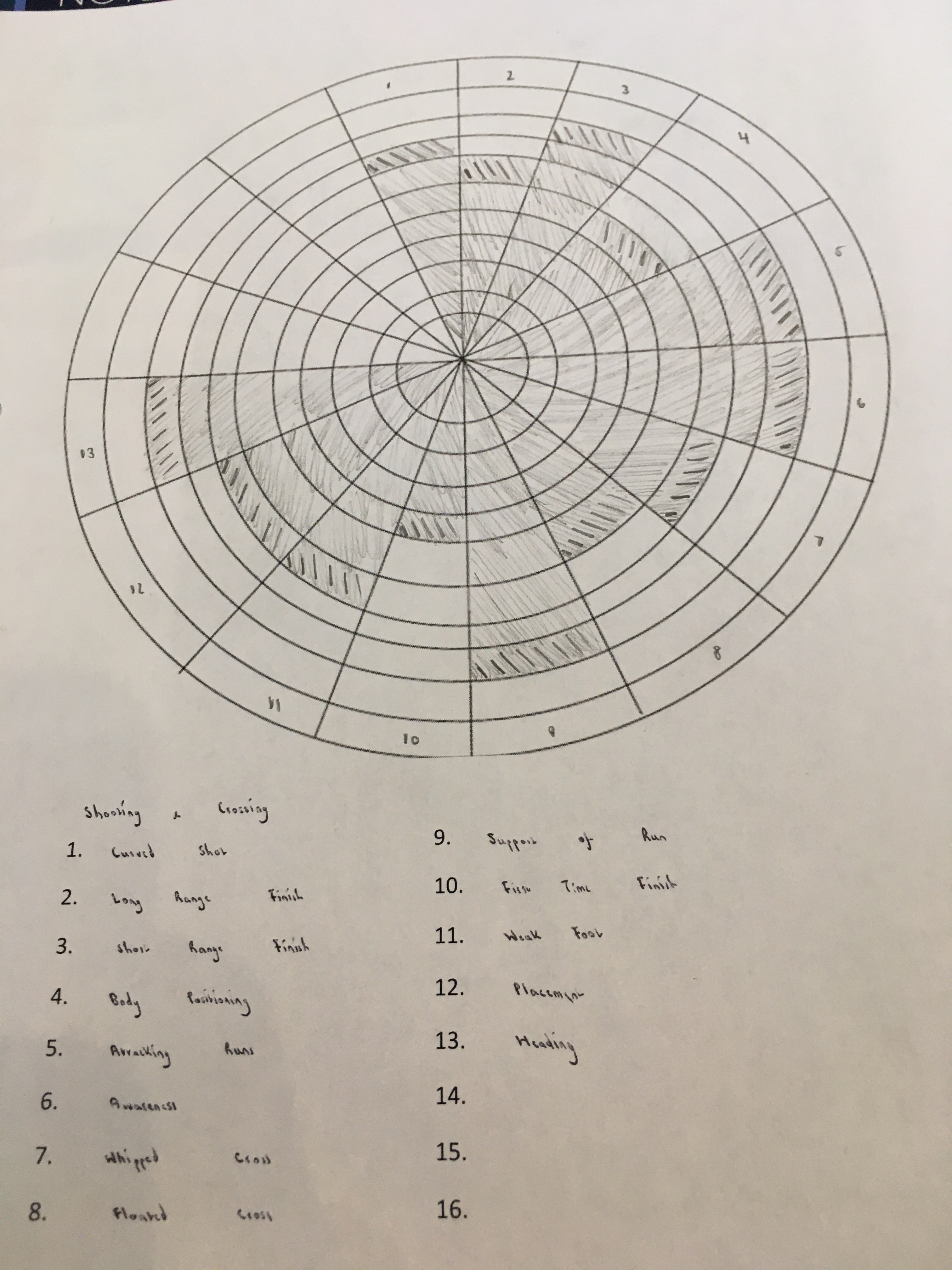
Shooting is the ability to slot the ball into the net, in the form of a volley, header, short-range/long-range shooting. Overall, the best finishers can gain goals from out of nothing – a dead ball or deflection, to an ambitious shot from anywhere.
Short-Range Finish:
The short-range is utilised when the opportunity is in the eighteen-yard box, either taken first time or with more touches.
To perform, the player should bring their body towards the ball and attempt to connect with their inside of the foot. As the ball would be whipped in with pace, it’s a better idea to bend the leg and connect with the inside first time, as the leg wouldn’t be floppy and lose direction with the ball. Similar to the passing before, the opposite foot should be place parallel to the striking foot, giving the other room to swing and connect, whilst guiding it preferably into the corner.
If the ball has too much pace, then it would be ideal to not swing into the ball, but merely just connect with the inside, guiding it into the net. This is because if the foot struck with a swinging motion, and the ball has too much pace, the ball would most likely be too hard to control and end up going over/horribly wide.
Approaching the ball is also different, as the runner should hold the run to be behind the ball; the objective isn’t too get level with the ball, as the body can’t swing as much and you’ll lose control. If approached correctly, as in behind the ball’s path, then the contact can be made with room to guide the ball.
In the video below, the player runs across the face of the box and manages to say behind the ball, allowing for his leg to cross and guide the ball into the corner of the net. The contact is also made with his inside sole, whilst keeping his leg bent, using the momentum from the pace of the cross. The finish is also placed in the corner, making it hard for the keeper to get across in time, as the keeper would be moving to the opposite end from the cross.
Long-Range Shooting:
The long shot is performed outside the eighteen-yard box, either with curve or power towards the net.
Before shooting, the player should take a look up and notice where the net and goalkeeper are, and where they themselves are positioned away from the net. If the body’s chest is facing towards the net, then the shot with straightness and venom is more suitable. Otherwise, if the chest and hips are facing away from the goal, then the curve is more appropriate.
For the straight shot (facing towards the goal), the striking foot should swing from the hip to gain power, whilst the non-striking foot is positioned slightly behind the ball, to the side. To gain extra power, the arms and chest should open up, whilst the body is bent to the opposing side of the striking foot, allowing greater range of movement in the swing for power. However, the body should be kept over the ball to prevent the ball from being raised too high. To provide straightness, the contact should be made onto the area around the inside sole/laces, otherwise the power would take the ball over the net whilst other areas would gain enough power as the ball isn’t raised from beneath.
The player in the video below takes a touch forward, leaving room for the body to open up and take on the shot – his hips are facing towards the goal, enabling the body to cause a swinging motion. With that, the body is kept over the ball, whilst the striking foot come from the hip, allowing the strike to gain more venom to direct it into the top corner, with contact at the area around the laces and inside sole, giving height.
For a curved shot (hips facing away from the goal), the non-striking foot should be placed a years from the call and pointing forty-five degrees away from the net, giving room for the other leg to swing across the body; the striking leg is bent to make contact with the inside sole’s toes. Doing this allows the ball the be curved with pace, causing the ball to quickly bend back towards the net. The body’s position should be over the ball and hunched downwards to keep the ball down.
Similar, the player’s hips are facing away from the goal, which leaves his leg to swing across his other leg to make contact at the inside sole’s toes. The hips are also shifting weight to the other side, as the body leans back once contact is made – by leaning back slightly, the ball is raised further into the air, to complement the spinning of the ball gained by hitting the area around the outside of the ball. The resulting spin causes the ball to swerve, which makes the keeper fall for the original flight of the ball, failing to get across once tricked.
Cross:
As a cross is whipped down from the byline, the positioning of the body should be timed to come towards the ball from behind. This way, the body can shift its weight across to gain power and direction on the shot, otherwise if level with the ball, it’s hard to turn and overall, the legs cross and block each other.
As approaching the ball, the attacker should identify where the goalkeeper is and chose what finish is appropriate – if the ball is still airborne then either a header (if above shoulders) or volley (volley if hip height), then if across the ground, it’s better to direct the ball with the inside sole, taking the pace with the cross. By identifying where the keeper is, the finish is directed against the keeper’s momentum, making them unable to get back across to deal with the shot.
As a cross is often curved or is straight across the box, the attack’s movement should be curved itself. That way, if the first player misses the ball, there’s another player positioned behind to take the touch – if the other player is ahead/in line with the other attacker, the player can’t react in time to the initial mistake and will most likely be off balance and lose the ball.
In the first and second video, the ball is put back across the box by a swinging motion from the hip, making contact at the outside right corner of the ball, giving swerve to bend backwards to the attacker.
However, in the first video the attack’s line is parallel with each other, in which the first player misses the flight of the ball, the second player is ahead of the ball, body is leaning back to recover the ball, causing the ball to fly and hit the crossbar. Unlike that, in the second video, the second attacker is slightly behind the ball by hiding his run, which allows him the get his technique correct once the flick on is provided. The technique is applied correctly as the attacker has time to react, as well as giving his body more space to not be over the top of the ball, which gives room to have a swinging motion, hitting the ball.
Week Seven: Formations & Tactics
A formation is the structure of a team – the core of how the team is set-up for a match. In order to achieve success, a formation is necessary for the efficiency of the defending transitions, and also the attacking prowess of teams.
The tactics of a side is the ability to display certain movements of play, either into a defensive or an attacking style of play, to help break down a defence or contain another type of attack.
For example, a team that plays with a high-line (tactics) may be countered with another team setting up a formation with five midfielders to quickly exchange the ball between themselves before their space is closed off, with the main striker pushing the back-line to open up more space for a on-surging midfielder, or dropping deeper to collect in the mountain of space left by the press (tactic).
Another example is that a team setting up with inside forwards/team that likes to play down the middle can be shown down the flanks or slowed down – narrow full-backs with little pressure on the ball from the midfield and defence, causing limited options to exploit.
Sometimes instructions to one specific player (tactic) can be influential; a team that plays out from the back often utilise individuals in the centre dropping deep to offload the ball further up, so by instructing one player to sit tight on that player, they’re forced to play elsewhere or backwards.
Overall Summary:
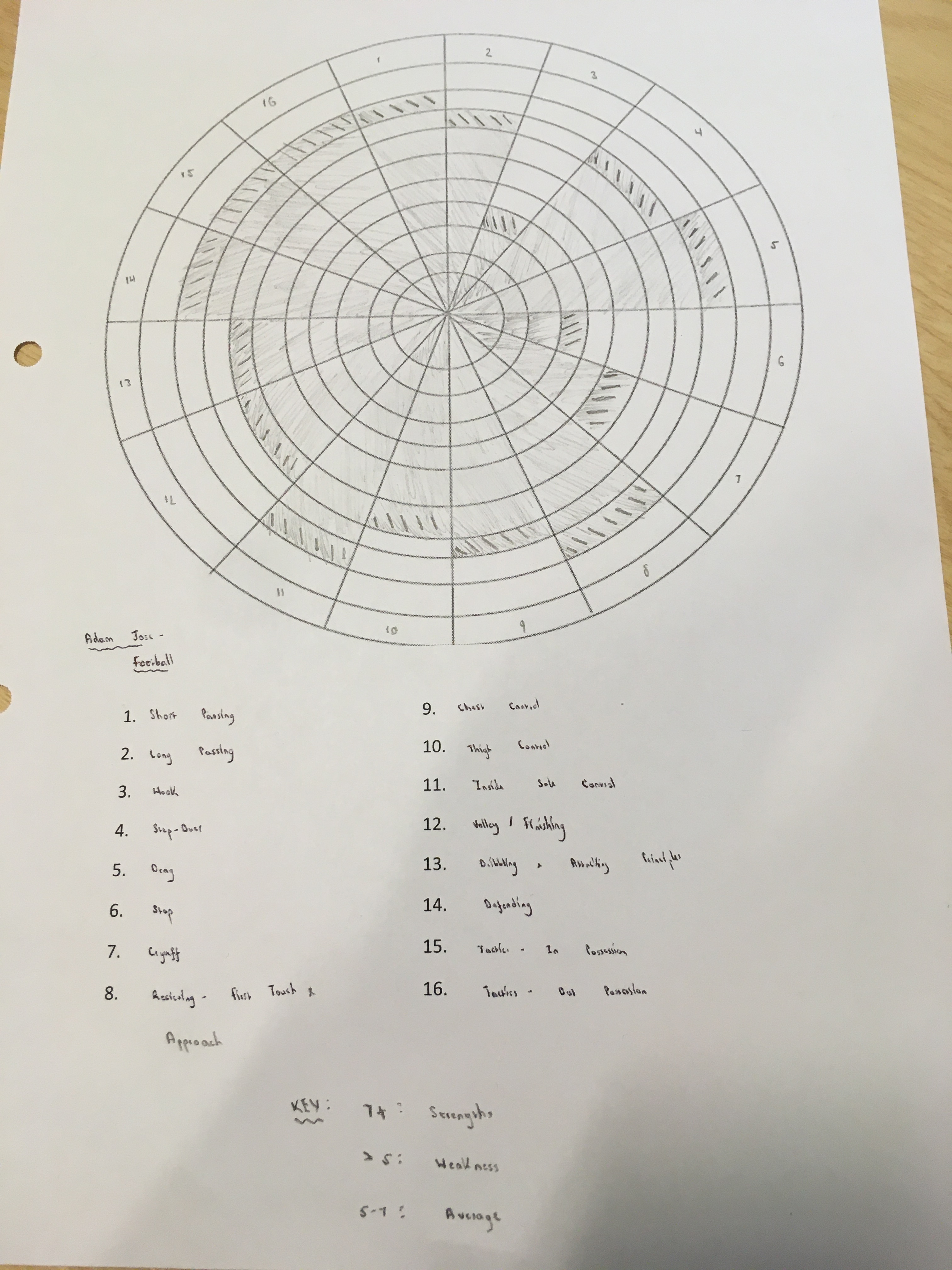
Short Passing:
1) The reasoning for my short passing being a strength is that I apply the appropriate technique all most all of the time; my foot makes contact at the centre of the ball, whilst pointing my non-striking foot in the direction of the target, whilst giving room for my hip to turn for a clean and powerful contact with the pass.
Long Passing:
2) Another strength is my long passing, as I apply similar technique and direction to my passes; non-striking foot pointing at the target to allow the other foot to swing across from the hip to maintain direction and power. The striking foot also lands onto the ball with its laces and slightly under, enabling enough height to be delivered to the pass, also brining my chest open to give height.
Hook:
3) My hook is a weakness as the approach my body to the ball is often too direct with the ball, leaving little room to turn, as it becomes obvious where the turn will be applied. Sometimes the turn is hit with the ankle, as opposed to the outside-foot, making the ball spin away even more – unable to control.
Step-Over:
4) However, my step-over is down with effective movement, making it one of my useful skills. The technique applied is used with the displacement of the body to feint and trick the defender, whilst my body is also positioned to the side for the step-over to go over the other side of the ball, allowing for quick turns or even more step-overs. Thus, my body can drive into more space quickly.
Drag:
5) Drag is another useful strength of mine as the skill is applied as I read the oppositions body, then usually perform a quick drag backwards with my sole then make contact with the inside sole of the same foot – cutting back across the body of the defender to drive into more space. This is also usually kept quite close to my body, allowing for effective control, which is done by the slightest of bends in my legs to give a lower centre of gravity – making my body turn quicker whilst applying minimal contact to the ball.
Stop:
6) Whilst I stop the ball with the sole of my foot, the stop is another weakness due to the shifting of my body’s weight over the ball, making the ball roll too fast into the back of my leg, losing control, whereas I don’t just slightly stop the ball with my sole by bending my legs for easier appliance of force.
Cruyff:
7) The Cruyff is average as of my inconsistency with performing it. Most of the time the turn is disguised as a cross by opening up the body and lowering the hip to swing the ball, which is then transitioned into a turn with the lower part of the inside-sole, making me turn with control and pace into space. However, other times the touch is applied lower down the foot, making the contact heavier and uncontrollable, whilst also positioning my non-striking foot slightly behind/not in line with the ball, thus the turn often hits my other leg.
Receiving:
8) The strength of my receiving comes from the constant awareness of those around me, so I can apply my body into a position where I can quickly turn or take the ball into more space – basically shielding the ball or opening up more space to do something.
Chest Control:
9) Often is a strength as I can take the ball down effectively due to my opening of the chest itself to absorb more of the impact, cushioning it to fall down towards my feet. Also, the body is slightly bent back, at times, making me able to also go into volleys, as the ball is bounced upwards, improving my versatility with the ball.
Thigh Control:
10) Like the Cruyff, this is average due to my inconsistency with the technique. I manage to perform it well as I bend my leg forty-five degrees downwards and keep my body straight, to help cushion the ball’s impact, whilst allowing the ball to drop for another controlled move, like a mid-air pass. Although, the ball is still at times being controlled slightly off to another side, as my body’s positioning at times is too far to one side, or my hips face another direction, directing the ball elsewhere instead of takin gun it down.
Inside Control:
11) My inside-sole control a strength as I can take any ball down with pace and quickly move into more space, or even play a mid-air pass. This is done by me having my body straight and my leg bent inwards – foot forty-five degrees facing downwards to hit the inside-sole. As this happens, my body, which is straight, jumps back or forwards to cushion the touch.
Volley:
12) The volley is performed at reasonable standards as I’m able to make sufficient contact with the ball by watching it, and bending my non-striking legs and hips down, allowing my striking foot to swing with room and make contact at the foot’s upper-laces (around the ankle). Despite all that, it’s average as of my hips also facing away from the target, causing the swinging legs to go around too much and shoot off goal.
Dribbling – Inside, Outside & Sole:
13) Dribbling on each my left and right feet are performed well with the inside & outside and the sole. I do this by slightly bending my legs for a lower centre of gravity to turn quicker, whilst using my arms to balance my movement. This allows the touches to be taken at angles, as my foot is pointing forty-five degrees away to move the ball past my body, and manoeuvre past others. Despite this, my dribbling is average due to my inability to have good co-ordination between both feet; whilst dribbling, the ball is only moved with one foot, and isn’t changed to open into more space with the other foot.
Defending:
14) Defending is a strength of mine as I am able to effectively deal with attackers – I keep my body side-on and low down to be ready to change pace/direction at any time in case of a attack going past, whilst also keeping little space in-between me and the attacker, as they have less to work with and this slows down the attack to get others into position, cancelling their attacking runs. On top of that, I have the composure to notice when the ball is moved too far from the defender, in which I then tackle at the soonest opportunity to win the ball.
Tactics (In Possession):
15) The idea of my knowledge of tactics in possession involves playing wide to stretch defences, with overlapping full-backs or players come short to play and keep ball, whilst utilising the ability to switch the play thanks to the defence being stretched, causing wide wingers to gain space to receive the ball. Forwards can also be used to drop deep to allow more space in-behind, as the striker drags players out of position and allows wingers to cut inside and relieve instead. The midfield can also push up to overload the opposition’s midfield and easily play between them, causing other midfielders or full-backs to come in and help, once again creating space behind. Full-backs can press higher or sit deeper to give an extra option to teammates, and if the attack is played down the wing, then different runs are created – one goes front post, another sits behind , maybe one on the edge of the box, to enhance the options of attack further.
Tactics (Out Of Possession):
16) Out of possession tactics involve the back-line keeps in shape as the ball is in midfield, in which they shift across to cover any potential gaps through the defence, and switching positions to cover once the ball is played down the flanks. The midfield can sit off or press high as a team to slow down attacks or limit options to pass, making the opponents force a rash decision; as each player presses, the ball is moved into a certain area in which another player closes down that space, with each passing player, the midfield covers to remove the ability for a simple through ball. The defence can be narrow with low-sitting wingers, covering any gaps through the centre and makes the others play down the flanks, which crosses are dealt with by the extra numbers thanks to sitting narrow. Midfield can also pivot – the idea is that one midfielder presses slightly whilst the other covers the space behind, removing the chance of a inside forward/winger or higher-sitting midfielder getting on with the defence.
Strengths:
When record receiving the ball, I make myself constantly aware of my surroundings in order to make quick decisions – play a first time pass or take an appropriate touch – to open up more space for myself or a teammate. For example, when in an area of space, I know I can take a quick touch and accelerate away, whereas under pressure, I would look for the quickest route out whilst protecting the ball. The quick passage of play enables me to take advantage and drive the play forwards.
My strength fitness component wise is the ability to turn direction under speed – agility. When dribbling, I can often avoid challenges thanks to my agility whilst maintaining my balance over the ball to change direction out of the way of defenders. For example, once under a restricted amount of space, the agility allows me to get o the space by changing my position over the ball quickly with speed to get out and drive forwards.
Weaknesses:
My lack of muscular strength hinders my ability to maintain balance over the ball to provide changes in direction when dribbling once there’s physical challenges from defenders. There also the element of not being able to defend the ball when shielding as I often am pushed off the ball and lose possession, not being able to drive the team forward on attacks.
My lack of shooting technique is also detrimental to my performance as my shooting is often met by a lack of power. This is due to my lack of appliance towards planting my non-striking foot a few feet away from the ball to allow my body to twist for power, whilst also having little prowess with opening my body to keep my shot, with pace, going straight. The lack of muscular strength contributes to this as of power being the momentum of speed and strength.
At times, my long passing can be faulty as of an inability to gain height on each pass, presumably as of my body’s positioning being detrimental – my non-striking foot isn’t straight and allowing my body to bend back, whilst my striking foot is rotated to make contact at the lower part of the ball with the laces. By making contact at the laces, the ball can be lifted from underneath, allowing more height to be gained on the pass.
Similarly, crossing isn’t a strong point as of the lack of pace and height gained on my crosses. This is due to my striking foot not being brought from my hip (side) and whipped around the ball to make contact with the ball at its bottom corner, for height and pace. Since height and pace isn’t gained, the target for the ball isn’t met straight as the lack of pace contributes to the ball being simple to read, and the lack of curve, allowing defenders to easily intercept the ball.
Personal Development Plan:
To benefit my lack of overall muscular strength, I could look to change my training to include more type of weight training; a form of training where the athlete works their muscles against a set level of resistance to develop them (https://www.truefitness.com.sg/fitness-101/readon/Training/types-of-training-weight-training).
For example, my routines could look to include a higher percentage of 1Rep Max weights, the maximum amount one person can lift do to one repetition, whilst keeping my reps and sets lower to avoid the chance of injury. This way my body works against a higher resistance to undergo progressive overload, a way of quickly developing Type 2 muscle fibers for greater levels of contraction forces (https://www.issaonline.com/blog/index.cfm/2018/type-iia-muscle-fibers-training-for-explosiveness).
By developing these fibers and muscles, my ability to generate greater volumes of strength under scenarios would be enhanced, also contributing to better performances of protecting the ball and win dead balls, since these require a resistance against other people’s strength. The additional strength could aid my balance when dribbling and shooting, allowing me to keep my body position over the ball to be correct throughout the skills – maintenance of power to drive forwards.
For my shooting, I know of why my ability is limited, and that’s due to my inability to plant my non-striking foot a few yards away from the ball to allow space to turn, whilst my striking foot isn’t brought from my hip for more power. So, to benefit this I would look to dedicate more time towards practicing my approach to the ball, ensuring that I make my position with my feet correct to feel almost automatic, then apply contact and power to the ball, linking the stages to create a continuous and efficient loop. Then, I would apply another link, where I direct the shots against various areas of a wall, and from there, then add different distances for accuracy. To improve this, I could practice a drill where I receive the ball under different circumstances, and take a touch/try to attempt a first time finish and apply a finish complementary to the scenario. This drill would allow me to be ac-knowledgeable of what my surroundings are, and direct my body towards my target, and apply the appropriate finish – whether that’s a long-driven shot or a short one.
My long passing can be benefited by practicing my run-up towards the ball, ensuring that my non-striking foot is planted a few yards in line, whilst being straight for my body to rotate and make contact with the laces. To do so, I should start out slowly and not even hit the ball, then slowly adjust to apply a proper running motion. As this happens, the run-up should become automatic in terms of being correct. Like the shooting drill, I could also practice locating areas of space every once in a while, and receive the ball, quickly adapting my body to play the ball.
Similarly, again, my crossing can be fixed by slowly applying my run-up towards the ball to meet the ball by making contact at the intended place, and bringing my striking foot from the hip, then apply more pace as it became accustom. Like the shooting, I would also receive the ball under a different scenario and scan for where I can pass the ball and adjust my body to apply the appropriate cross. This way my body is customary to different types of crosses, like back-post runs or pull-backs, which each require different amount of pace and curve.
 PTS Football - Adam Jose